
"Lip Wizard" Dr. Jihyeon Kim's Lip Filler Notes · Part 1 (of 7)
Lip Filler: Design Comes Before Volume
Dr. Jihyeon Kim, Medical Director, Bello Clinic ·
When I meet someone, the first thing I notice is their lips. Call it an occupational habit. For some reason, I’ve been fascinated by lips since I was twenty. Whenever I saw someone beautiful, I’d study them and ask, “Why are these lips so pretty?” It became a long-time hobby, and now I can look at a pair of lips and immediately see, “This is how they could be even prettier.”
In my consultation room, there are two things I hear more than anything else.
“Please keep my natural lip shape and make it look natural.”
“So how much should I get?”
I don’t answer the second question right away. The amount is a number that comes at the very end of the consultation. Once we decide what kind of lips we’re creating, the amount almost takes care of itself.
In this series, I’ll walk you through the order in which I look at lips in my consultation room, over seven parts. Whichever clinic you go to, you can use it as a guide for what to ask and what you should hear in a consultation.
“Natural” vs. “Plump”
Most lip filler consultations begin with one of these two words.
Natural means keeping the shape of your current lips largely the same and only filling in what’s missing — preserving your original lip shape while adding a bit of life. Plump is a glamorous style, filled so that anyone can see the volume. Neither one is the right answer. It simply depends on your taste and your face.
The problem is that “natural” means different things to different people. One person’s “natural” is another person’s “plump.” That’s why photos are more accurate than words — and I’ll talk separately about how to prepare those photos in Part 4.
People often ask, “It looks natural only if I get a little, right?” That’s only half true. Some lips look awkward with just 0.5cc, while others can take 1cc and no one can tell. What separates the two is not the amount but the design — whether the filler went into the right places, in a shape that suits that face.
The most common worry I hear in consultations comes back to this, too: “Won’t it look like too much?” The higher someone’s standard of beauty, the bigger this worry tends to be. But lips that look overdone usually look that way not because there’s too much filler, but because the shape doesn’t match the face. Well-planned lip filler doesn’t announce itself; instead, it softens your expression and your overall impression.
How Lip Trends Have Changed
In consultations, I often feel that the lips people want have clearly changed.
The lips that were popular five to ten years ago look artificial today. There was the so-called “bird-beak” — a pointed, raised center of the lips — a strongly emphasized Cupid’s bow (the M shape of the upper lip), curves pushed as far as they’d go, and generous volume on top. You could tell at a glance that filler had been done, and the attitude was, “If it’s pretty, who cares if it shows?”
Today, it’s the exact opposite. The biggest feature is keeping your own lip shape as much as possible. Lips that look like “My lips have always been like this,” rather than “I got lip filler.” We hardly ever create a bird-beak anymore; instead of emphasizing curves, we fill them in to soften them, and we add a moderate amount of volume. People prefer a round, soft look. In a word: natural lips that look like your own.
That’s also what I consider most important in lip filler. Undetectable, and beautiful.
The Areas I Pay Close Attention To
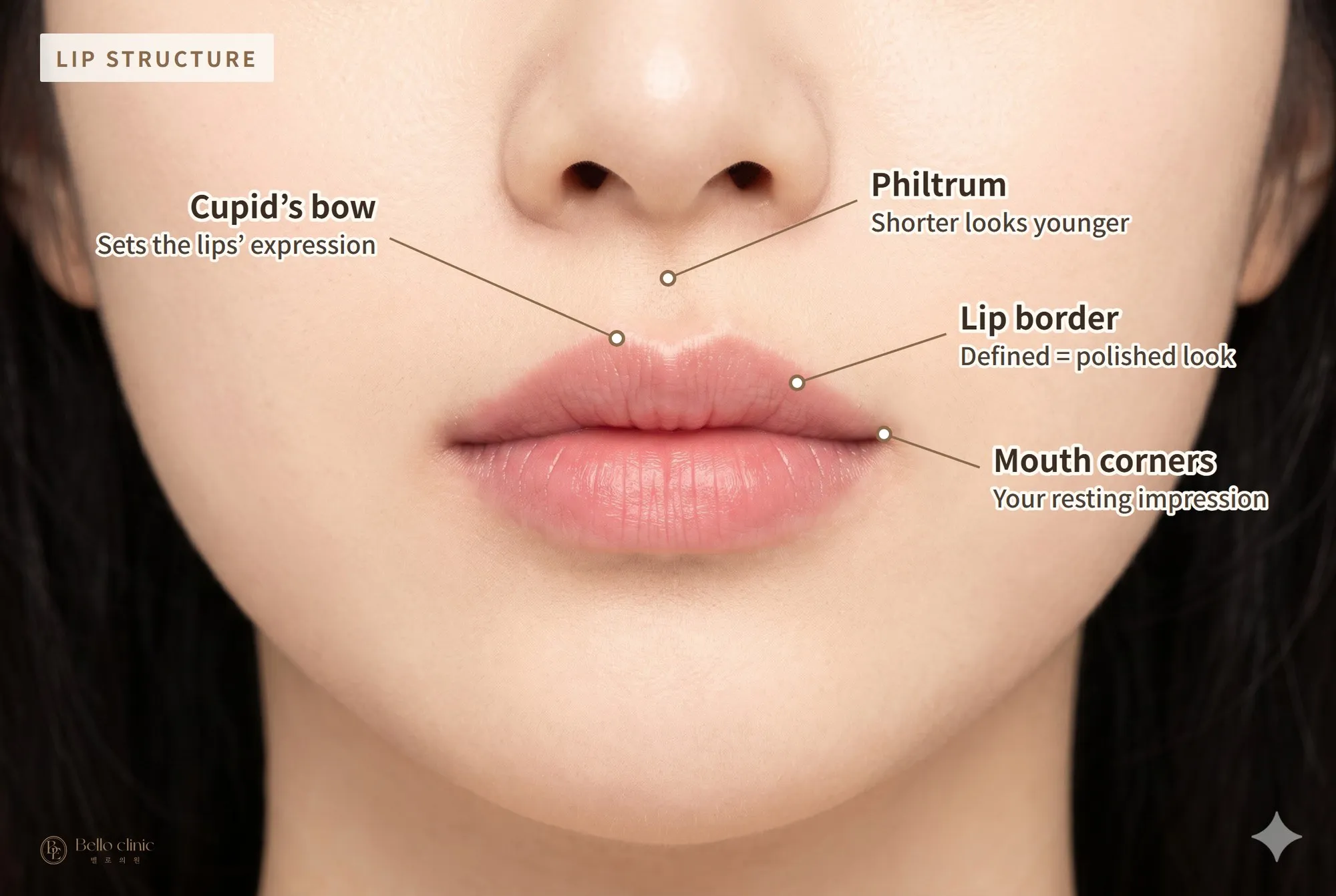
- Lip border (vermilion border) — The line where the red of the lips meets the skin. When it’s well defined, the lips look neat and polished.
- Cupid’s bow — The M-shaped curve at the center of the upper lip. This is where the lips’ expression is set.
- Mouth corners — They determine your impression when your face is at rest.
- Philtrum — The length above the lips. The shorter it looks, the younger the face looks.
Lip filler isn’t only about adding volume. Widening the lips slightly, making the philtrum look shorter, refining the mouth corners, and balancing the left and right sides are all part of what lip filler can do. I’ll go through these one by one in Parts 3 and 4.
The Ratio of Upper to Lower Lip
Textbooks often cite an upper-to-lower lip ratio of 1 : 1.6, but that’s based on Western faces. In my experience, many people find a ratio with a slightly fuller upper lip — around 1 : 1.2–1.5 — more natural.
You can check this at home. Take a front-facing photo with your mouth closed, and measure the thickest part of your upper lip and your lower lip. If your upper lip is less than half the thickness of your lower lip, your upper lip is on the thin side. I understand the wish to fill only the upper lip, but once the upper lip becomes thicker than the lower lip, the face starts to look unfamiliar regardless of the amount. In that case, we need to look at the lower lip as well.
Before the numbers, though, what matters is balance with the whole face. Some lips look pretty on their own but too much once you see them on the face. When the volume is excessive, the lips don’t get prettier — the facial proportions break down instead. So when I design lips, I keep the mirror a little farther away and look at the whole face. I decide on volume and lines while looking at the lip shape and thickness, the philtrum length, and the proportions of the entire face together. My standard isn’t overinflated lips, but lips that look like they were always part of your face — lips that look refined even up close.
A Small Change That Shows a Lot
The lips are an area where a small change makes a big difference. When we talk, we look back and forth between the other person’s eyes and mouth, and the lips are a different color from the rest of the face, so even a slight change in shape catches the eye. That’s why adding just a little volume to the lips can change your whole vibe and impression.
There are times when the face in the mirror somehow feels dull — Koreans have a slang word for this, eoltaegi, a kind of “face fatigue.” For people who are considering a major procedure at a time like that, I sometimes suggest starting with the lips. The degree of change can be kept small, and the lips alone can bring the whole face back to life.
The flip side is that even a small mistake shows a lot. A slight left-right difference, a little too much volume — these stand out right away. That’s why I talk about design before volume, and why I recommend starting small at first.
Next time — So how much should you get? I’ll explain why I never go over 1cc for first-timers, and why the same 1cc gives different results for different people.
Dr. Jihyeon Kim, Medical Director, Bello Clinic