
"Lip Wizard" Dr. Jihyeon Kim's Lip Filler Notes · Part 3 (of 7)
Change the Shape of Your Lips, and Your Facial Proportions Change
Dr. Jihyeon Kim, Medical Director, Bello Clinic ·

Lip filler is commonly known as “a treatment that makes your lips bigger.” The way I see it is a little different. To me, it’s a treatment that changes facial proportions. When you change the shape of the lips, the philtrum looks a different length, the face looks a different width, and even the side profile changes. In this part, I’ll describe three directions in which the lips change your facial proportions.
First, the Overall Image of the Face
Before measuring any proportions, there’s something I look at first: the overall image of the face. The same plump lips can look lovely on one face and, on another, look like only the lips are sticking out.
On a face with defined, striking features, even generous volume in the lips doesn’t look overdone — in many cases it actually brings out the overall balance. A face with a pure, understated image is different. Rather than emphasizing the lips as well, correcting asymmetry or just refining the lines is far more harmonious.
The most important thing in lip filler isn’t the lips themselves, but how those lips look on the face.
Making the Philtrum Look Shorter
Every time you look in the mirror, the middle of your face — what we call the midface — may seem long and bother you. The length of your nose can’t be changed with an injection, but the philtrum can be made to look shorter.
The philtrum is also related to age. As we get older, the philtrum gradually lengthens and the upper lip thins, so a short philtrum and a full upper lip make a face look younger. That’s why lip filler is sometimes called a “baby-face” treatment.
When the goal is to shorten the philtrum, I mainly work on the upper lip. By bringing out the upper lip border so that a little more of the red lip shows toward the top, the distance from under the nose to the lips looks shorter. When the philtrum looks shorter, the middle of the face looks less long and the impression becomes younger. As the midface shortens, the face also looks more refined.
Here, controlling the amount is everything. If you inject too much out of eagerness to shorten the philtrum, it backfires. Only the upper lip gets thick, the upper-lower balance breaks down, and the first thing people notice is “she’s had filler.”
There’s a way to gauge whether your philtrum is really on the long side. A common guideline for the lower face says it looks balanced when, if the distance from under the nose to the line where the lips meet is 1, the distance from that line to the tip of the chin is about 2. Try drawing lines on a front-facing photo. You’ll be able to tell whether your philtrum is actually long, or just looks long because your upper lip is thin. If it looks long because your upper lip is thin, bringing out the upper lip alone makes a real difference.
If the philtrum is longer than this ratio, the middle of the face looks long, giving a mature, slightly older impression. For these people, simply lifting the volume and line of the upper lip slightly upward and outward makes the overall impression softer and younger. On the other hand, for people whose philtrum is already short, shortening it further looks unnatural and just wastes filler. For them, filling the upper lip softly in a horizontal direction looks more natural than raising it upward.
Lip Flip Botox as an Option
If the philtrum is the main concern, I use Lip Flip Botox instead of filler, or together with it. It’s a treatment that slightly relaxes the muscle around the upper lip so the lip rolls upward and outward, making the upper lip look fuller and the philtrum shorter without adding volume. It also works well for people whose upper lip gets thin when they smile, or whose gums show.
Filler fills volume; a lip flip relaxes the muscle to change the line. So when the two are done together, you can use less filler and create a more natural line.
The procedure itself is simple. Very small amounts are placed at several points around the upper lip border. The change isn’t visible that day; it appears over 2–4 weeks as the upper lip gradually rolls up.
I should be clear about the limits, too. It doesn’t create volume the way filler does — it’s a subtle change, the lip just rolls up slightly — and because it’s Botox, it gradually returns to the original state within a few months. In the early days after treatment, using a straw or making “p” and “b” sounds may feel a little awkward. And if the philtrum itself is very long, it’s beyond what injections can solve.
Widening Horizontally So the Face Looks Slimmer
The lips aren’t only something to enlarge up and down. If we bring out both sides so that a little more of the red lip shows toward the mouth corners, the lips look longer horizontally. Then the cheek area beside the lips looks smaller, and the face looks noticeably slimmer.
So for people who worry that their face is wide, I bring up horizontal width before volume. If only the center of the lips is filled plump, the mouth can look small and gathered into a round shape, making the face look relatively wider.
There’s a limit to horizontal widening, too. I don’t fill volume all the way to the tips of the mouth corners; I keep the natural flow that tapers toward the corners while slightly lengthening the visible red part of the lips. Overdo it, and instead of the face looking slimmer, only the mouth looks big. And if someone with a narrow face widens their lips too much, the balance doesn’t work either.
Chin Length and the Lower Lip
I look at the lower lip together with the chin. If someone with a short chin gets a lot of volume in the lower lip, the chin looks even shorter. Conversely, if the chin is on the long side, giving the lower lip a moderate amount of volume improves the proportions of the whole face.
The Line Seen in Side Profile
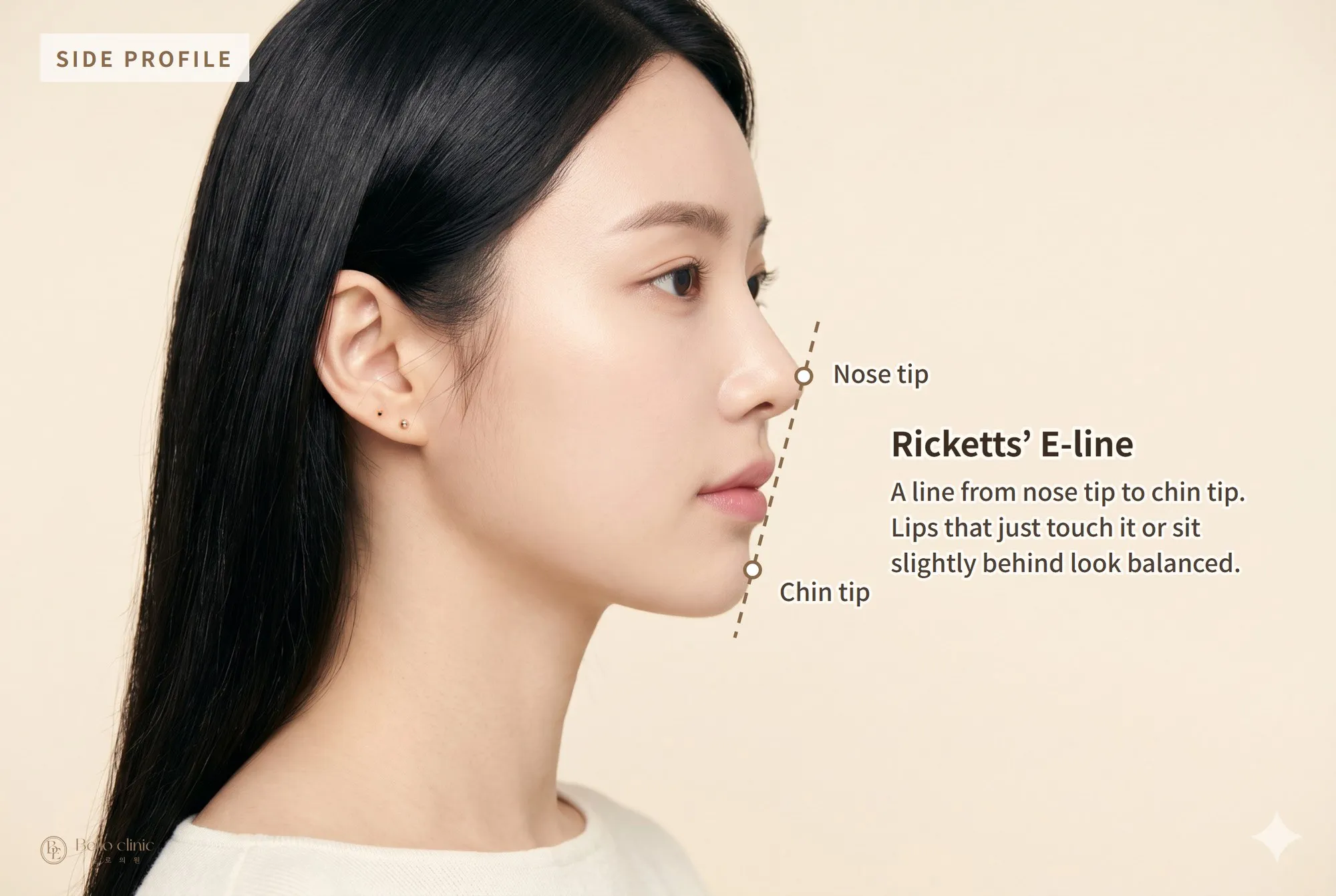
The lips aren’t only seen from the front. In side profile, I always draw a line connecting the tip of the nose and the tip of the chin. It was proposed by the orthodontist Ricketts, so it’s called Ricketts’ E-line, or simply the E-line. When the lips just touch this line or sit slightly behind it, the side profile looks balanced.
If someone whose mouth already protrudes a little gets a lot of volume, the front view may look pretty, but the side profile becomes heavy.
You can try this at home, too. Take a side-profile photo and place a ruler against the tip of your nose and the tip of your chin. If your lips stick out past the ruler, your face is one where volume needs care; if they sit well behind it, your face is one where adding volume won’t make the profile heavy. For an accurate photo, don’t tilt your head up or down — keep looking straight ahead.
If Your Mouth Protrudes but You Also Want a Shorter Philtrum
This is where the design changes. Shortening the philtrum involves a lot of work on the upper lip, but for someone with a protruding mouth, adding volume to the center of the upper lip, right below the philtrum, makes the mouth look like it sticks out even more.
For these people, I bring out the lines on both sides of the upper lip rather than the center. Encouraging horizontal widening toward the sides gives the upper lip presence without increasing forward-projecting volume, and the face looks slimmer. So even when two people say the same thing — “I want a shorter philtrum” — where the filler goes depends on their side profile.
Lips in Motion
After looking at the front and the side, I ask you to talk and smile. Lips in a photo are still, but real lips move all day long. Many people’s lip thickness differs quite a bit between rest and smiling, and some people have a habit of smiling only on one side. Some people’s upper lip rolls in so much when they smile that it almost disappears; others move only the lower lip a lot when they talk. If I design based only on how the lips look at rest, for these people the lips become different lips the moment they smile. That’s why, during consultations, I deliberately get you talking a lot and ask you to smile big.
This movement also affects how the filler settles after treatment. It connects to the touch-up discussion in Part 5.
A Side Note: Aegyo Sal Filler
It’s not the lips, but it works on the same principle, so I’ll note it here. Aegyo sal filler — filler for the small roll of “charm fat” just under the eyes — makes the eyes look bigger and even gives an effect similar to an outer-eye-corner surgery (lateral canthoplasty), so the face really comes alive. Looking younger is a bonus.
Widening the lips horizontally, shortening the philtrum, and aegyo sal filler are ways to get prettier without anyone knowing. But if any of the three is overdone, it shows right away and looks heavy-handed. Done naturally to suit your face, no one will know unless you tell them.
Looking at the Lips from Three Directions
To sum up, I look at the same lips from three directions: up and down — the philtrum and the chin; left and right — the width of the face; front and back — the side profile. When these three conflict — for example, when you want a shorter philtrum but your mouth protrudes — deciding which to prioritize is exactly what design is.
Next time — The cases where I tell patients in consultation, “That’s not possible.” Where the limits of filler lie when it comes to mouth corners and asymmetry, and a single table showing what to address first for each lip type.
Dr. Jihyeon Kim, Medical Director, Bello Clinic